Fusion is our core feedlot management platform. It brings the major parts of your operation into one system so feeding, processing, animal health, inventory, billing, compliance, and reporting work together instead of pulling your team in different directions.
The goal is not to add more software to your day. The goal is to make the work easier to manage, easier to do correctly, and easier to see clearly. Fusion helps feedlots improve consistency, reduce costly mistakes, and operate with more confidence and control.
Fusion is built to support the real day-to-day work of a feedlot, not just one department or one narrow workflow.
It connects:
Because these areas work inside one integrated system, information does not have to be re-created in multiple places. Your team can work from the same data, use the same system, and make decisions with a clearer view of what is happening across the yard.
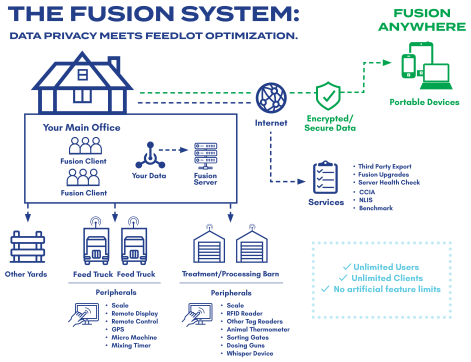
At the center of Fusion is your local system and your local data. Fusion is installed on computers you own and operate at your facility, and the different parts of the platform work together around that foundation.
Office staff and managers use Fusion to manage rations, review feed data, process invoices, run reports, and configure workflows. Feed truck operators use Fusion to guide mixing and delivery. Chute and health crews use it to capture animal data, follow treatment protocols, and keep accurate records while work is happening.
Instead of treating software like a passive record book, Fusion is designed to participate in the work. It captures information during the job, performs calculations automatically, and gives people the guidance they need to work faster and more accurately.
Fusion is best understood through six core ideas. Together, they describe how the platform is built to serve a working feedlot.

Fusion is built to be current, maintainable, and ready to keep evolving. It is mature enough to be trusted in serious operations, but it is not meant to feel stuck in the past.
Fusion is designed to cover the real complexity of a feedlot. Some systems are built for simpler needs and a lighter scope of work. Fusion is built for operations that need more depth across feeding, health, inventory, billing, compliance, and reporting, so the system can support serious management needs as the yard grows and changes.
Fusion is built to reduce friction for everyday work. The goal is not to remove capability. The goal is to make the software easier to use correctly, easier to learn, and easier for employees to work with under real feedlot conditions.
Fusion does more than store information after the fact. It helps employees while the work is being done by looking up information, performing calculations, guiding decisions, and automating data capture where possible.
Fusion is designed as one connected system rather than a collection of disconnected tools. Feeding, health, office work, reporting, and other operational areas work together so information flows where it needs to go.
Fusion is built around the belief that your business data should remain under your control. Your data stays on your own system, and it does not leave without your permission.
Feeding is one of the clearest examples of how Fusion turns software into a practical operational tool.
Fusion supports ration management, bunk calls, feeding protocols, actual ingredient tracking, and feed delivery workflows in one connected process. It helps management define how feeding should happen, then helps the crew carry that out with more consistency and less guesswork.
Dry matter workflows, protocol-driven decisions, and accurate load tracking help the yard manage feed more precisely. That matters because small errors repeated across time can become meaningful losses. Fusion helps make those details visible so they can be controlled.
This is also where the platform supports less-experienced employees especially well. Instead of relying only on memory, math, or individual judgment, the system provides structure and guidance during the work itself.
Fusion extends beyond the office into the feed truck, where accuracy and consistency matter every day.
Fusion Truck guides mixing and feed delivery in the cab and can continue working without a constant Wi-Fi connection back to Fusion Server. More broadly, Fusion is built around a local yard system, so the core platform does not depend on internet access to keep the operation running day to day.
Features such as guided delivery and GPS-based wrong-pen protection help reduce expensive mistakes and support more consistent feeding practices. This makes the work more manageable for drivers and gives management a better view of what actually happened in the yard.
Fusion also supports the high-pressure work that happens at the chute.
By connecting with equipment such as tag readers, scales, and dosing tools, Fusion can capture animal data while processing is taking place. It can calculate doses, display instructions, and help crews move through the work with less screen interaction and less manual entry.
Veterinarian-defined treatment protocols can also be built into the system so employees have clearer guidance when treating cattle. That helps improve consistency, supports less-experienced staff, and creates better records for later review.
The result is not just faster data entry. It is a more reliable workflow for processing, treatment, withdrawal tracking, and animal-level history.
Fusion is not only about recording what happened. It is also about helping you see where money may be leaking out of the operation.
Because Fusion tracks actual usage in key workflows, it can support stronger inventory visibility and more accurate billing. For custom feeding operations, that can mean billing based on actual ingredient quantities delivered rather than rough averages. For management, it can mean a better view of shrink, overages, and usage patterns that would otherwise be easy to miss.
This is one reason Fusion is often understood as an investment rather than just another software expense. When important details become visible, they can be managed.
One of Fusion's strongest differences is that it is built as an integrated platform.
That matters because feedlots often feel the cost of fragmentation in subtle ways: duplicate entry, inconsistent records, extra office cleanup, slower reporting, and uncertainty about which numbers to trust. Fusion is designed to reduce that friction by keeping core operational information connected.
When feeding data, health data, inventory activity, billing, and reporting all live within the same system, the software becomes easier to trust and easier to use as a management tool.
Fusion is designed for real teams, not idealized teams.
Most feedlots feel pressure from labor shortages, training challenges, and the difficulty of finding experienced people for every role. Fusion helps address that reality by guiding employees through work, standardizing important decisions, and reducing the amount of knowledge that must live only in one person's head.
Protocols, prompts, permissions, and workflow-specific guidance help employees get productive faster and make fewer costly mistakes. This supports both day-to-day consistency and long-term training.
Data privacy is not an afterthought in Fusion. It is part of the design from the start.
Fusion is built around the principle of putting you in control of your data. Your operational data lives on your own system, at your own site, and does not leave without your permission. That gives you control over access, control over history, and confidence that your business information remains yours.
For many feedlots, this is more than a technical preference. It is a business principle. Fusion is designed to give you modern software capability without requiring you to give up ownership and control of your operational data.
Fusion is built for feedlots that want a better way to manage complexity, improve consistency, and run a more profitable operation.
It is a strong fit for teams that:
It is especially well suited to operators who see software as a management tool, not just a record-keeping tool.
Want to see how Fusion works in a real feedlot workflow? Schedule a call and we will walk you through it.